


How to Compare Home Insurance Quotes in Miami: A Step-by-Step Guide for 2026
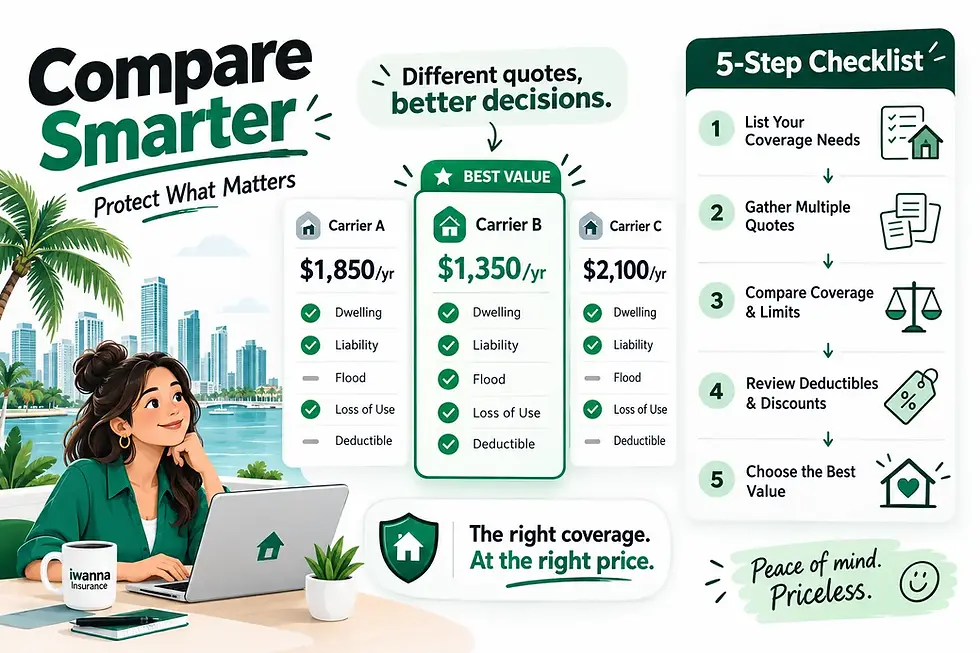
Miami homeowners insurance in 2026 ranges from roughly $3,400 to over $15,000 per year for similar homes. That spread isn't random, and it's rarely the result of one carrier being greedy. It comes down to what each policy actually covers. Many homeowners compare quotes by glancing at the annual premium, picking the lower number, and calling it done, an approach that works fine for streaming subscriptions but can leave you massively exposed when a storm rolls through. This checklist walks you through the exact steps to compare home insurance quotes in Miami the right way: from gathering your home specs to reading the hurricane fine print to understanding what drives those premium swings across Miami-Dade neighborhoods.
At Iwanna Insurance, we're a Miami-based independent agency that runs these comparisons for South Florida homeowners every day. We see firsthand what trips people up. The issues are almost always the same, and almost none of them are about price, they're about coverage gaps that only show up after a claim.
Why the cheapest Miami quote isn't always the better deal
Two policies at different price points can look equal until a claim happens. The goal when you compare home insurance quotes in Miami isn't to find the lowest number, it's to find the best value for the coverage you actually need. That requires understanding a few distinctions most homeowners don't think about until it's too late.
Replacement cost vs. actual cash value: the gap that hurts after a storm
Replacement cost value (RCV) policies pay what it costs to rebuild. Actual cash value (ACV) policies subtract depreciation from that number before writing your check. In Miami, where construction costs per square foot run significantly above the national average, that depreciation gap can be substantial. An ACV policy might look several hundred dollars cheaper per year until a hurricane takes out your roof and your insurer pays you what your 15-year-old roof was worth in depreciated dollars, not what a new one costs in 2026. That's a real scenario our clients encounter, and it's an illustrative example of what we see in claims situations far more often than we'd like.
Policy limits that leave you underinsured without knowing it
Many Miami homeowners set their Coverage A (dwelling) based on the home's purchase price or a Zillow estimate rather than its true rebuilding cost, a common pitfall agents flag regularly. Market value includes land; rebuilding cost doesn't. But rebuilding cost includes current labor and material prices, which have climbed sharply in Florida through the post-storm years. Carrying $280,000 in dwelling coverage on a home that would cost $420,000 to rebuild is a hypothetical gap that becomes painfully real after a major loss. The premium savings you pocket each year are nothing compared to the shortfall you'd be writing a personal check to cover.
What to have ready before you request any quote
Walking into a quote comparison unprepared leads to inconsistent numbers that can't be compared accurately. If you give different information to different carriers, you'll get quotes built on different assumptions. Apples-to-apples comparison only works when everyone is working from the same data.
Your home's key specs: what every carrier will ask
Every insurer needs the same core information: year built, square footage, construction type (frame, masonry, or mixed), roof shape (hip vs. gable), roof age and material, and prior claims history. These aren't formalities, each one directly moves your rate. A hip roof in Miami typically earns better wind credits than a gable roof. Masonry construction generally rates better than wood frame for wind resistance. Knowing these details before you shop puts you in control of the conversation instead of relying on a carrier's assumptions.
How to calculate your actual dwelling coverage number
The right Coverage A amount comes from local cost-per-square-foot rebuild figures, not your home's market value. Miami construction costs in 2026 are well above the national average due to labor demand, materials costs, and South Florida's building code requirements that followed Hurricane Andrew. A working estimate: multiply your home's finished square footage by current local rebuild cost figures, in Miami, that often falls in the range of $250 to $350 per square foot depending on construction type and finishes, then factor in high-end finishes, custom features, or permitted additions. That number, not your mortgage balance or tax-appraised value, is the foundation of a sound coverage comparison.
How to compare Miami home insurance quotes on hurricane, windstorm, and flood coverage
This is where Miami home insurance gets genuinely different from the rest of the country. Standard policies, hurricane deductibles, and separate flood policies operate under different rules and carry separate deductible structures. Understanding all three is essential before any quote comparison makes sense.
How Florida's hurricane deductible actually works
Florida homeowners policies carry a separate hurricane deductible on top of the standard all-peril deductible, and it's almost always percentage-based, not a flat dollar amount. Common structures are 2%, 5%, or 10% of Coverage A. On a home insured for $400,000, a 5% hurricane deductible means $20,000 out of pocket before the insurer pays a cent on a hurricane wind claim. When you compare home insurance quotes in Miami, two policies at the same premium but with different hurricane deductible percentages are not the same product. This is one of the most commonly overlooked variables in quote comparisons, and it's one of the first things we check when a Miami homeowner brings us quotes to review.
Why flood insurance is always a separate policy in South Florida
Standard homeowners policies don't cover flood damage, including storm surge, the water pushed inland by a hurricane's winds. In Miami-Dade, where a significant portion of homes sit in FEMA-designated flood zones, this matters enormously. Flood insurance is purchased separately, either through the National Flood Insurance Program (NFIP) or a private flood carrier. An elevation certificate can significantly lower flood premiums for homes in certain zones. Two identical homes on the same block can carry very different flood insurance costs depending on their elevation data, which means comparing flood policies without that certificate first is guesswork.
Windstorm endorsements and what to look for in your declarations page
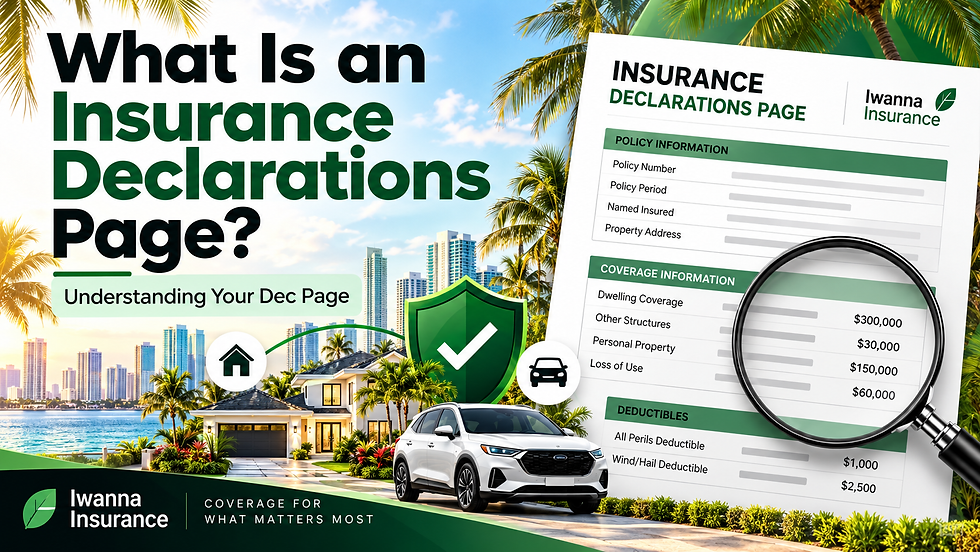
For some Miami-area properties, particularly those close to the coast, the standard homeowners policy may limit or exclude wind coverage entirely, requiring a separate windstorm endorsement or policy. To check this, go to your declarations page and look at the listed perils and any exclusions in the wind and hurricane section. If the policy doesn't mention windstorm or lists it as excluded, that's a critical coverage gap. No premium discount makes up for a policy that won't pay when a major storm hits.
The discounts and mitigation credits that can seriously change your premium
Miami homeowners have more mitigation discount opportunities than most markets in the country. The key is knowing what qualifies and what documentation insurers actually require before applying any credit.
Wind mitigation inspections: what they check and what they save
A licensed inspector evaluates six key features using the Florida Uniform Mitigation Verification Inspection Form: roof covering, roof deck attachment, roof-to-wall connections, roof shape, secondary water resistance, and opening protection (hurricane shutters or impact-rated windows and doors). Inspection costs vary by provider and typically fall in the range of $150 to $300, and the resulting credits can save meaningful amounts on the wind portion of your premium, sometimes hundreds of dollars annually, sometimes more depending on your home's features. Insurers require the completed form before applying any credits. This is not a self-reported discount, and an older form may not document recent upgrades you've made, consider scheduling a re-inspection if you've made changes since your last one.
Two Miami examples worth knowing
A Miami homeowner with a hip roof, reinforced roof-to-wall connections, and impact-rated windows will carry meaningfully lower wind premiums than a same-size home with a gable roof and no opening protection. The mitigation credits on the first home can reduce the wind portion of the premium substantially. Separately, a home in a Miami-Dade flood zone with an elevation certificate showing the structure sits above the base flood elevation will pay far less for flood insurance than an otherwise identical neighbor without one. In some cases, that certificate cuts the annual flood premium in half. These are outcomes we've documented for clients across the Tri-county area.
Other discounts worth stacking
Newer roofs rate better in Florida, and carriers will typically want permits and roofing contracts to document installation date and materials. Bundling home and auto with the same carrier usually earns a multi-policy discount without any additional paperwork beyond linking the policies. Claims-free history credits require no documentation beyond the insurer confirming your record. Stack these where you can, but never reduce actual coverage to qualify for a discount. The math rarely works out in your favor after a claim.
How to compare Miami-Dade home insurance companies side by side
With your specs in hand and your coverage needs understood, the actual comparison is more straightforward than most people expect. The challenge is knowing which data to trust and which tools to use correctly.
Start with FLOIR CHOICES as a market map, not a quote
The Florida Office of Insurance Regulation's CHOICES tool shows sample average rates for standardized model scenarios by county, not actual quotes for a specific home. Use it to identify which carriers are actively writing policies in Miami-Dade and to get a rough sense of where each one sits in the market. Current carriers writing in Miami-Dade include Citizens, Tower Hill, Universal Property, Kin, State Farm, Travelers, Allstate, and Slide, with annual homeowners insurance rates in Miami ranging from roughly $1,976 to over $30,000 depending on carrier, location, and coverage profile. That range is why CHOICES is a starting point, not a decision tool.
What to evaluate beyond the premium number
Once you have multiple quotes built on the same coverage structure, layer in three additional dimensions before deciding. Claims reputation matters: how fast does the carrier pay, and how often do they dispute claims in Florida's post-storm environment? State market conduct reports and consumer complaint ratios from the Florida Department of Financial Services are good places to check. Financial strength is equally important, review AM Best or Demotech ratings before committing. Finally, read the policy-specific exclusions and endorsements carefully, because they often differ between carriers in ways that aren't obvious from the premium line. A carrier that takes six months to process claims or routinely underpays is not a deal, regardless of how the premium looked when you signed up.
Getting a free, expert comparison on how to compare home insurance quotes in Miami
Running this entire process yourself is doable, but it's time-consuming, and the details matter enough that small misreads carry real consequences. A single overlooked hurricane deductible difference or an expired mitigation form can cost far more than any premium savings.
Iwanna Insurance is a Miami-based independent agency that works with multiple carriers and runs side-by-side comparisons for homeowners at no cost. Because we're independent, we're not locked into one carrier's offerings. We can quote Citizens alongside private carriers, compare NFIP flood policies against private flood options, and explain the actual difference between two policies beyond the premium line. As illustrative examples of what a thorough comparison can uncover: a homeowner in West Miami who hadn't updated their wind mitigation form in eight years found meaningful annual savings after we flagged the outdated form and arranged a new inspection documenting upgraded roof-to-wall connections. A Coral Gables homeowner insured with Citizens moved to a private policy with a lower hurricane deductible percentage after a side-by-side comparison showed a private carrier could match the cost with broader coverage. A real comparison, done correctly, tends to surface exactly these kinds of opportunities.
What this all comes down to
How do you compare home insurance quotes in Miami to find the best deal? You look past the premium at what each policy actually covers when it matters. Coverage A limits, hurricane deductible percentages, flood policy options, and mitigation credits are all variables that can change your real cost of a claim by thousands of dollars. The cheapest quote on paper can be the most expensive decision you make.
Use this framework at every renewal, not just when you first buy. Carriers adjust rates, mitigation forms age out, and your home's rebuild cost changes over time. If you'd rather have a local expert run the comparison for you, contact Iwanna Insurance. We offer free, side-by-side quote comparisons for Miami-Dade homeowners across multiple carriers, including flood options specific to South Florida. Reach out before your next renewal date and know exactly what you're getting.


Comments